

A GE Profile refrigerator making a knocking noise is one of the more unsettling calls we get, because the appliance usually still works. In this case, the unit was cooling normally — the temperature held and the food inside stayed cold — but the compressor had developed a sharp, repeating knock every time it cycled on. That combination, a refrigerator that works but sounds broken, is exactly where a precise diagnostic matters more than a guess.
Here is what the diagnostic found, and the full restoration that followed — recovery, a nitrogen flush, a new compressor, and a vacuum verified by instrument readings rather than a stopwatch. Each step exists to protect the same thing: the integrity of a precision-engineered sealed system once it's closed back up.
What a Knocking Sound from a GE Profile Refrigerator Means
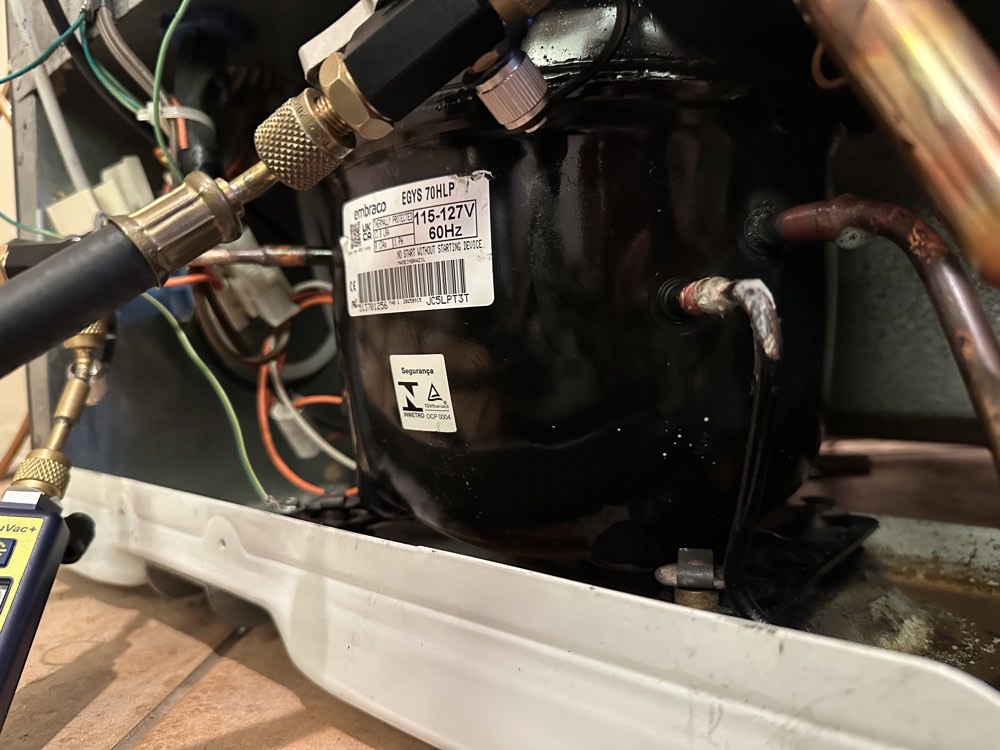
A repeating knock, timed to the compressor's cycle, almost always points to a mechanical fault inside the compressor itself rather than a loose part elsewhere in the cabinet. The compressor houses a sealed motor and pumping assembly that compresses refrigerant gas on every cycle; when an internal mount, valve, or bearing wears, that motion produces an audible strike instead of a smooth hum.
The compressor can continue cooling correctly for weeks or months after the knock first appears — which is why many owners wait, assuming the noise isn't serious since the fridge still feels cold. That's different from a compressor that runs constantly without cooling at all, a separate symptom covered in our guide to refrigerator compressor running but not cooling. In this case cooling was never affected; the knock was the only symptom, and it does not resolve on its own.
How We Traced the Noise to the Compressor
A knocking sound in a refrigerator can come from several places: a condenser fan blade striking ice or debris, a loose ice maker bracket, or a vibrating rear panel. The first step of the visit was isolating the source — listening directly at the compressor housing while the unit cycled, and ruling out the fan, defrost components, and panel hardware one at a time.
In this case, the knock was coming from inside the compressor housing itself, timed exactly to the compressor's run cycle rather than to anything external. In our experience restoring refrigeration systems, a noise that starts and stops with the compressor cycle — rather than running continuously or only during defrost — is the clearest signal that the compressor itself, not a peripheral part, is the source.
Why the Compressor Gets Replaced, Not Just Quieted
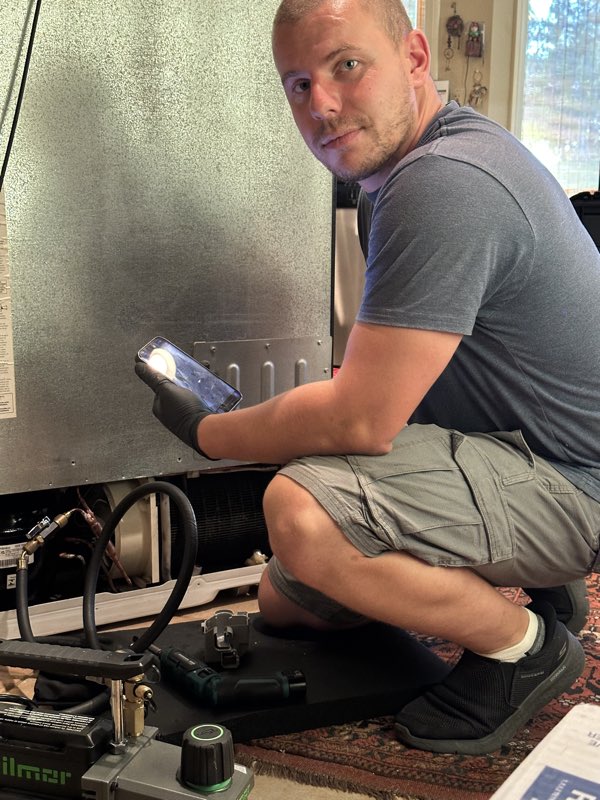
Once a compressor develops this kind of mechanical knock, the restoration path is replacement, not a quieter workaround. The internal wear causing the knock does not improve on its own — it progresses toward a seized motor or a ruptured internal line, either of which turns a contained repair into a full refrigerant leak.
Replacing the compressor on a sealed system means opening a circuit that was never designed to be opened casually. Every step after that point exists to make sure the system is as clean and dry inside as it was before the compressor failed.
What a Nitrogen Flush Does During a Compressor Swap
A nitrogen flush pushes dry, inert nitrogen gas through the entire refrigerant circuit to clear out moisture, oil residue, and debris left behind by a failed compressor before a new one goes in. We recovered the existing refrigerant, removed the old compressor and filter-drier, then ran a full nitrogen flush through the lines before brazing in the replacement parts.
Nitrogen also plays a second role during the brazing itself — flowing it through the lines while the joints are heated prevents oxidation scale from forming inside the copper, which would otherwise flake loose later and contaminate the system. We brazed in both a new, genuine OEM compressor and a new filter-drier, since the filter-drier is the component that traps any remaining moisture and acid before it can reach the compressor.
How We Pressure- and Leak-Tested the New System
With the new compressor and filter-drier in place, we pressurized the sealed system with nitrogen and checked every brazed joint with a soap-bubble solution, watching for the telltale bubbling that marks an escaping leak. No bubbles appeared at any joint, and the system held its test pressure without dropping. A pressure test that holds steady over time is the only reliable way to confirm a brazed joint is sound — a visual inspection alone cannot catch a pinhole leak. It's the same nitrogen pressure test that confirmed a hidden evaporator coil leak in a Thermador refrigerator that had stopped cooling entirely — the method doesn't change whether the fault is a worn compressor or a punctured coil.
Why We Pull Vacuum by Microns, Not by the Clock
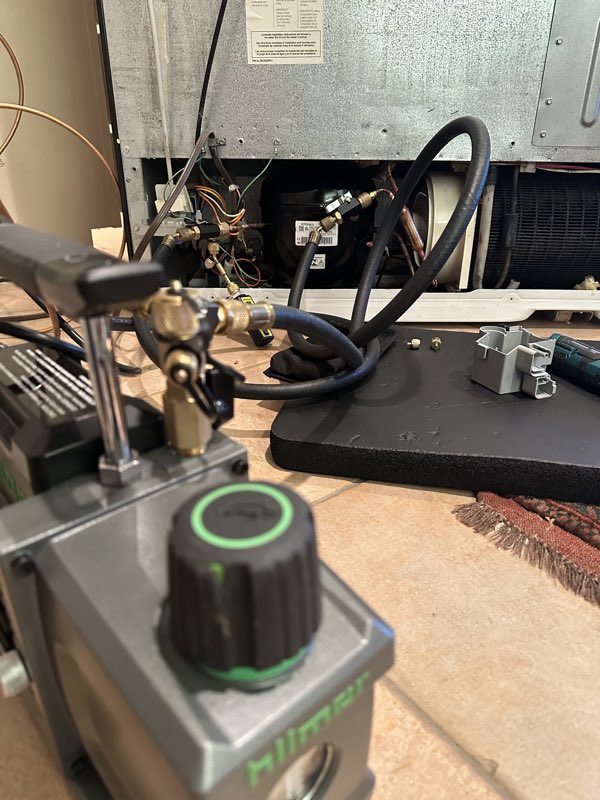
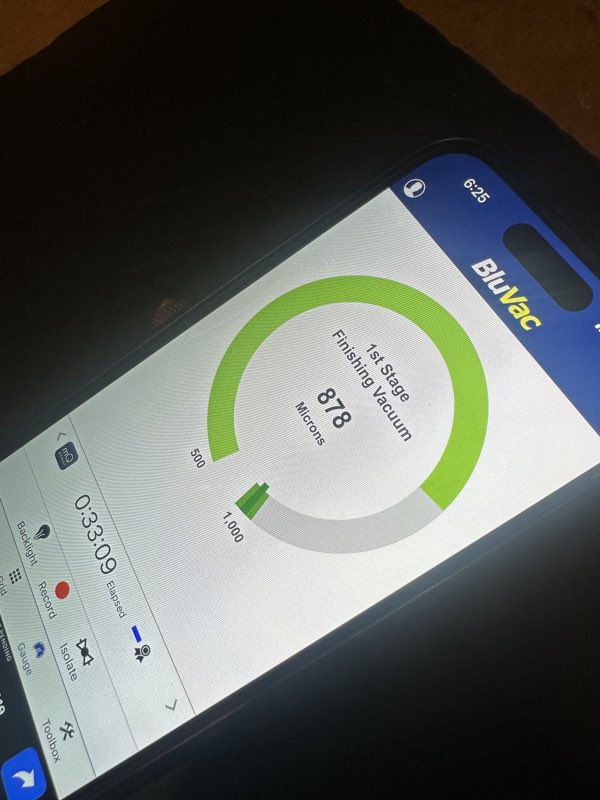
A vacuum pulled on a timer can still leave moisture trapped in the compressor oil or at a leak point too small to see, which is why we measure the vacuum by instrument rather than by the clock. Using a micron gauge, we pulled the system down to approximately 490 microns — below the roughly 500-micron threshold that confirms residual moisture has been removed from a refrigeration circuit.
Time-based vacuuming is a guess; a micron reading is a measurement. Two systems can be vacuumed for the identical number of minutes and have very different amounts of moisture left inside, depending on ambient temperature, line length, and how much moisture was present to begin with.
What the Decay Test Confirmed Before Recharging
A decay test isolates the system under vacuum and watches whether the micron reading climbs — a result that reveals whether a leak or trapped moisture remains before refrigerant goes back in. After reaching 490 microns, we closed off the system and let it sit; the reading rose to approximately 1,000 microns and held there, which confirms a sound, dry system rather than an active leak or residual moisture.
A small, stable rise during a decay test is the expected result on a properly repaired system — it's the number holding steady, rather than climbing indefinitely, that confirms system integrity before recharging. With that confirmed, we recharged the refrigerant, restarted the unit, and asked the client to monitor it over the following 24 hours.
Frequently Asked Questions
Does a knocking refrigerator always mean the compressor needs to be replaced?
Not always, but a knock that is timed exactly to the compressor's run cycle usually does. Other knocking or rattling sounds can come from a condenser fan blade striking ice or debris, a loose ice maker bracket, or a vibrating panel — a diagnostic visit isolates which one is actually happening before any part gets replaced. LG refrigerators are a notable exception worth knowing about separately, since their linear compressor design fails on its own more often than the reciprocating compressors used in GE and most other brands; see our guide to LG refrigerator compressor failure if that's what you own.
Is it safe to keep using a refrigerator that is knocking?
Short-term, yes, if the unit is still holding temperature — the knock itself is a mechanical symptom, not an immediate safety issue. It is worth having it diagnosed promptly, though, since the wear causing the knock typically progresses and can eventually lead to a full refrigerant leak rather than a contained compressor swap.
How long does a compressor replacement take?
The restoration itself — recovery, nitrogen flush, brazing in the new compressor and filter-drier, leak testing, and vacuuming — is typically completed in a single visit. We ask clients to monitor the unit for about 24 hours afterward to confirm stable temperatures before considering the job fully closed out.
Why does a refrigerator need a vacuum and decay test instead of just being recharged?
Any moisture or air left inside a sealed refrigerant system reacts with the refrigerant and oil over time, forming acid that damages the compressor and shortens its life. The vacuum and decay test are how we confirm the system is dry and leak-free before that refrigerant goes back in, rather than finding out months later that it wasn't.
What does a diagnostic visit for a noisy refrigerator check?
A diagnostic visit isolates the actual source of the noise — compressor, condenser fan, ice maker, or cabinet hardware — before recommending any repair, since each has a completely different restoration path. The $99 diagnostic fee is applied toward the cost of the repair if you move forward with the work.
What to Do Next
If your GE Profile refrigerator — or any refrigerator — has developed a knocking sound timed to its compressor cycle, the most useful next step is a diagnostic visit rather than waiting to see if it resolves. The sooner the source is isolated, the more likely the repair stays a contained compressor restoration rather than a refrigerant leak. We provide refrigerator repair across San Diego County, including La Jolla, Rancho Santa Fe, and Del Mar, with white-glove floor and cabinet protection standard on every visit.